Artist biography
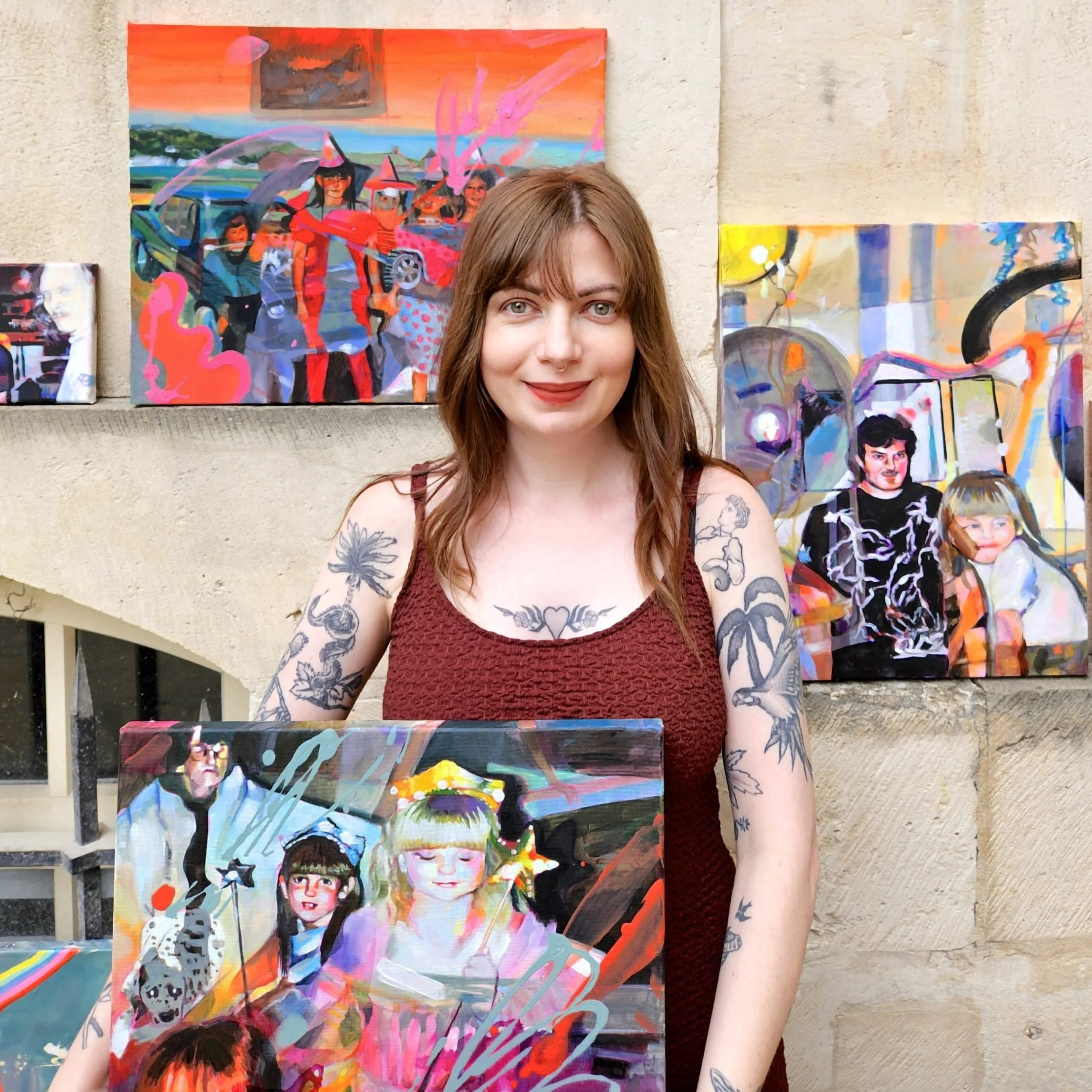
Sarah Pardi is an emerging painter based in Paris, France. Her work explores memory, family, class, and scenes from everyday life. By combining figurative work with gestural and abstract elements, Pardi’s work is reminiscent of collage and scrapbooking, with personal history and memories playing together.
Raised in deep rural poverty in Oregon’s Umpqua Valley, Pardi began painting at a young age as both a creative outlet and a way to make sense of the world around her. Her work is deeply inspired by the traditions of familial storytelling, ancestry, and creating visual records. Rather than portraying poverty as something inherently tragic, Pardi depicts its complexity: the coexistence of hardship, resourcefulness, intimacy, boredom, and joy.
Through sometimes fragmented narratives, Pardi’s paintings encourage viewers to recall their own histories and experiences, nostalgically, but with curiosity.
Pardi holds a Bachelor’s in Art, Painting and Drawing from the University of Oregon’s School of Architecture and Allied Arts. Her work is rooted in nostalgia, hauntology, and the idea that memory is a kaleidoscope.
Artist Statement
My work is mostly figurative, where the form is blended with a mix of expressionist abstraction, collage-like transparencies, and layering. Working on canvas with acrylic, liquid ink, glossy resin, and occasionally pastel, my pieces range from intimate, small formats to larger canvases.
I begin each painting with figurative forms, then break them apart through several layers of abstraction. Using masking tape to make hard edges and borrowing effects from film photography—such as drop shadows and blown-out areas—my work achieves a nostalgic, scrapbook quality without becoming sentimental.
Driven by my background in multi-generational, deep rural poverty, and rooted in a love for storytelling, my artwork approaches memory as something both fluid and constructed. I use fragmentation and obscured forms to capture how personal history evolves over time and how, no matter what we do, we cannot detach ourselves from our pasts. Rather than presenting hardship through a lens of pity, I highlight the deep nuances of working-class life, where adversity, warmth, joy, and resilience all bounce around in the same space.